Because of You, 2.2 Million Students Are Being Formed in the Faith
Because of generous supporters like you, Catholic Online School has already delivered free, faithful Catholic education to over 2.2 million students across 193 countries. In an age of noise and algorithms, you are helping form souls with truth, prayer, Scripture, and Christ.
If everyone who reads this gave just $5 — the cost of a coffee — we could reach even more families and keep this life-changing formation free for all. Be Courageous. Be Catholic. Stand with us today.
DONATE TODAY >St. Anicetus
Facts
Author and Publisher - Catholic Online
Printable Catholic Saints PDFs
Shop St. Anicetus
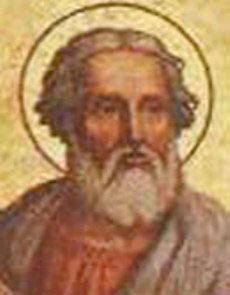
St. Anicetus, the tenth successor of St. Peter, served as Bishop of Rome during a formative and often difficult period in the early Church, with his pontificate generally dated from around 155 to 168 AD. He succeeded Pope St. Pius I and guided the Christian community at a time when the faith was still spreading throughout the Roman Empire and facing both internal doctrinal challenges and external uncertainty.
Anicetus was a Syrian from the city of Emesa, in modern-day Homs. His background reflects the increasingly universal character of the early Church, which drew leaders not only from Rome but from across the broader Mediterranean world. Though little is known about his early life, his leadership would prove significant in preserving the integrity of Christian teaching.
A central concern of his pontificate was the defense of the faith against heresies, particularly Gnosticism and Marcionism. Gnostic groups claimed that salvation came through secret knowledge, while Marcion rejected the Old Testament and presented a distorted understanding of God and Christ. Anicetus worked actively to oppose these movements and prevent their spread, safeguarding the apostolic tradition handed down from the earliest disciples. According to later tradition, he also enforced certain disciplinary practices among the clergy, including a prohibition against long hair, possibly in response to customs associated with heretical groups.
One of the most notable events during his time as pope was the early controversy over the date of Easter. This dispute arose between the Eastern and Western parts of the Church. In the East, Christians celebrated Easter on the fourteenth day of Nisan, in keeping with the Jewish Passover, regardless of the day of the week. In Rome and the West, however, Easter was celebrated on a Sunday, the day of Christ’s Resurrection. During this controversy, St. Polycarp of Smyrna, a disciple of St. John the Apostle, traveled to Rome to meet with Anicetus. Although the two could not reach an agreement on a common date, their meeting is remembered for its spirit of charity and mutual respect. Anicetus even permitted Polycarp to celebrate the Eucharist according to the Eastern custom while in Rome. This disagreement would continue and intensify in later centuries before eventually being resolved.
The pontificate of Anicetus also drew other important visitors to Rome, including the early Christian historian Hegesippus. His visit is often seen as evidence of the growing importance of the Roman Church as a center of unity and authority within Christianity.
Anicetus died around April of the year 168. Some later traditions claim that he was martyred during the reign of Emperor Lucius Verus, but there is no reliable historical evidence to confirm this. He was buried in the cemetery of Callistus in Rome, a resting place for several early popes. He was succeeded by Pope St. Soter.
His feast day is associated with two different dates due to historical variations in the Church’s calendar. April 17 was traditionally observed in earlier liturgical calendars and is still found in many older sources. However, the modern Roman Martyrology now lists his feast on April 20. This difference likely arises from early uncertainty about the exact date of his death, as sources variously recorded April 16, 17, or 20. Over time, the Church standardized the celebration on April 20 in the current official calendar, while April 17 remains in traditional usage.
St. Anicetus is remembered as a faithful defender of orthodox belief and a wise leader who upheld unity without compromising truth. His response to heresy and his charitable handling of disagreement, especially in his encounter with St. Polycarp, continue to serve as an example of both firmness in doctrine and generosity in spirit.

Come Grow With Us
Sign up and walk the Catholic journey with millions around the world.
Receive inspiring emails on saints, daily readings, and free faith-building resources—no cost, ever.
Sister Sara Has One Message for Every Catholic Family This June
- 7 Morning Prayers
- Mysteries of the Rosary
- Litany of the Bl. Virgin Mary
- Popular Saints
- Popular Prayers
- Female Saints
- Saint Feast Days by Month
- Stations of the Cross
- St. Francis of Assisi
- St. Michael the Archangel
- The Apostles' Creed
- Unfailing Prayer to St. Anthony
- Pray the Rosary










Copyright 2026 Catholic Online. All materials contained on this site, whether written, audible or visual are the exclusive property of Catholic Online and are protected under U.S. and International copyright laws, © Copyright 2026 Catholic Online. Any unauthorized use, without prior written consent of Catholic Online is strictly forbidden and prohibited.
Catholic Online is a Project of Your Catholic Voice Foundation, a Not-for-Profit Corporation. Your Catholic Voice Foundation has been granted a recognition of tax exemption under Section 501(c)(3) of the Internal Revenue Code. Federal Tax Identification Number: 81-0596847. Your gift is tax-deductible as allowed by law.